Third-party, always
Every certificate comes from an independent laboratory with no stake in the sale, so results reflect the tested sample — not the supplier's interests.
Quality · Certificate education
A COA is a laboratory report for a specific tested sample. Understanding the identifiers, methods and results helps you review your peptide lot documentation with confidence.
Looking for your lot’s certificate?
Browse the original reports in our Certificates of Analysis library.
The credibility standard
Before you read a single number on a certificate, look at who produced it. Wholesale American Peptides products are tested by independent third-party laboratories — not by the manufacturer grading its own work. A certificate is only as credible as the laboratory behind it, and the standard that separates a professional testing lab from a self-declared one is ISO/IEC 17025, the international standard for testing and calibration laboratories.
Accredited laboratories operate inside regulated, audited frameworks held to the high standards expected in the medical and analytical sectors: calibrated and traceable instruments, validated test methods, documented quality systems and independently assessed competence. That is what gives a purity or identity result weight when you review a peptide lot — and why we publish the original reports instead of summary claims.
Every certificate comes from an independent laboratory with no stake in the sale, so results reflect the tested sample — not the supplier's interests.
The international benchmark for testing laboratories: technical competence, validated methods, calibrated equipment and audited quality systems, assessed by an independent accreditation body.
Regulated laboratory environments with traceable records and controlled procedures — the same rigor demanded of medical-sector analytical testing.
Traceability first
A product name alone is not enough. Match the lot number before comparing results. A COA documents the tests shown on that report; it is not regulatory approval, a clinical claim or permission to use a research compound in humans or animals.
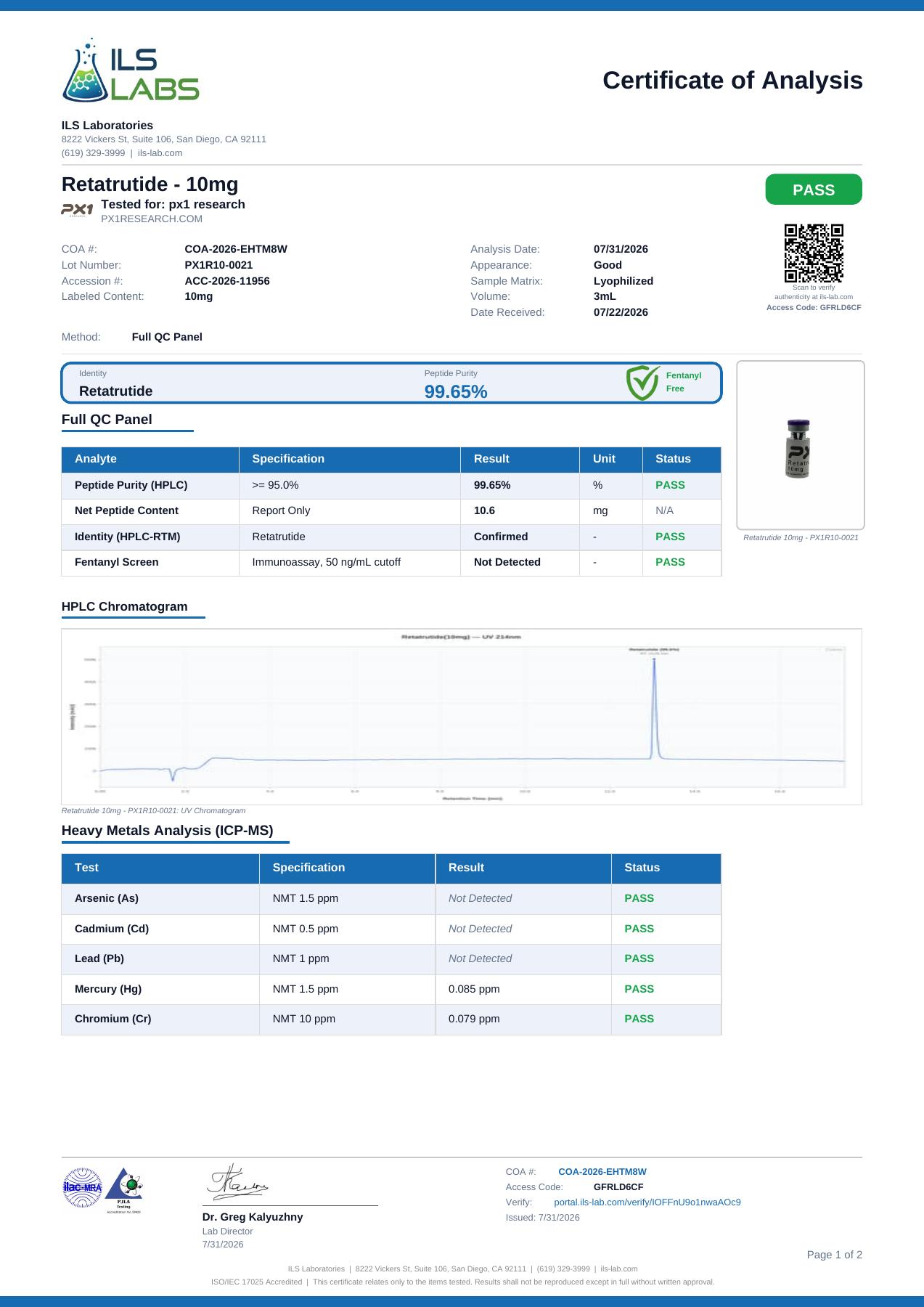
Lot PX1R10-0021 and labeled content 10 mg identify this sample. The laboratory uses the name Retatrutide for the compound sold in our catalog as AP3-R.
PASS is the laboratory’s overall result. Still check each assay: the net-content row is Report Only and has no pass/fail specification.
The purity result is 99.65%, against this report’s stated ≥95.0% specification. The chromatogram appears below the panel. These numbers describe this lot, not a universal catalog threshold.
Net peptide content is reported as 10.6 mg. Identity is Confirmed by HPLC retention-time comparison, not mass spectrometry on this certificate. Content, identity and purity are separate measurements.
The ICP-MS panel lists each heavy-metal result against its own limit. Page 2 contains sterility, endotoxin results and method notes. Only the tests actually shown should be attributed to this report.
Use the laboratory QR code or verification details and access code on the certificate. Check the lab director’s authorization and both pages of the original PDF; the signed report is the source of truth.
Reading the results
Start with the sample name and labeled amount. The lot or batch identifier should match your vial or packing slip. A certificate for a different strength or lot is not a substitute for your batch documentation.
Check: product name · labeled amount · lot number
Look for the laboratory name, report or certificate number, sample identification and testing date. Review any stated accreditation scope — ISO/IEC 17025 accreditation shows the laboratory's technical competence and quality system were assessed by an independent accreditation body. A report date is not automatically a manufacturing or expiration date.
Check: issuing lab · COA number · test date
High-performance liquid chromatography separates components in a sample. Reported area-percent purity describes the relative chromatographic peak area under the stated method. It is not the percentage of the vial’s labeled milligrams, and it does not establish sterility or safety for human use.
Read: method · chromatogram · reported purity
Mass spectrometry can compare the observed molecular mass with the expected mass of the peptide. Read the identity result and the method used alongside the purity result. An identity test and a purity test answer different questions.
Read: expected mass · observed mass · identity result
Content or quantitation measures how much peptide is present, often reported in milligrams per vial. Read the measured amount, units and any stated acceptance criteria. Do not calculate peptide content from an HPLC purity percentage alone; if content is not reported, do not assume it was measured.
Read: measured content · units · stated specifications
Where included, review results for endotoxins, heavy metals, residual solvents or sterility. Compare the result with the report’s stated limits and units. Not detected means below the stated detection limit, not necessarily zero. Never assume a test was performed when it is absent from the report.
Read: actual tests · limits · units · report notes
HPLC purity and mass-spectrometry identity refer to peptide sequences, not our AP H2O. Bacteriostatic water is sterile water containing 0.9% benzyl alcohol, supplied in 10 mL vials. We do not claim an HPLC purity percentage or mass-spectrometry peptide identity for this diluent.
Certificate & accreditation FAQ
Expand a question to see how we think about laboratory accreditation, purity and content results, and lot documentation.
ISO/IEC 17025 is the international standard for testing and calibration laboratories. A laboratory that holds it has had its technical competence assessed by an independent accreditation body: qualified staff, validated and documented test methods, calibrated instruments traceable to national standards, controlled environments, proficiency testing and an audited quality system. Accreditation is granted to a laboratory for named methods and scopes, not to a product or a brand.
A certificate is only as credible as the laboratory behind it. In an accredited laboratory, the result you are reading was produced under controlled, audited procedures rather than a self-declared claim, so the number can be compared across lots and suppliers with confidence. That third-party rigor is the standard we hold the laboratory reports we publish to.
A self-declared report is produced and graded by the party selling the material, with no outside assessment of how the testing was done. An accredited third-party report comes from an independent laboratory whose methods, instruments and competence are periodically reviewed by an accreditation body. For a research buyer, that distinction is the difference between a number and a verifiable measurement.
Ask the supplier for the laboratory's name and accreditation certificate number, then look that certificate up on the accreditation body's public register and open its scope of accreditation. The scope lists the specific methods the laboratory is accredited for. Accreditation covers named methods and scopes, so a laboratory being accredited in general does not mean every test on your report falls inside that scope.
No. Accreditation describes how a laboratory operates, not what was run on your sample. Always read the report itself: the methods listed, the results returned, the units and the stated limits. If a test you expect is not shown, it was not performed on that sample, and no accreditation statement changes that.
No. A purity result is an analytical measurement under a specified method. It does not establish clinical safety, sterility or suitability for human or veterinary use. Our products are for laboratory research only.
Purity describes the relative chromatographic composition of the tested sample. Quantitation measures peptide content. A vial’s labeled amount should be evaluated against a reported content measurement, not inferred from the purity percentage.
It means the substance was below the laboratory's stated detection or quantitation limit for that method, not that the amount is exactly zero. Read the limit and the units printed on the report; a test with a higher detection limit is simply less sensitive, and different laboratories can report different limits for the same analyte.
Most peptide reports include identity by mass spectrometry and purity by HPLC, and many also report peptide content or quantitation. Depending on the method ordered, a panel can extend to water content, residual solvents, heavy metals, microbial limits or endotoxins. Panels vary by laboratory and by what was requested, so compare what is actually printed on your report rather than assuming a standard set.
A certificate documents tests run on a specific sample on specific dates. Lyophilized peptide stability depends on storage, container closure and handling, so a laboratory report does not automatically confer an expiration date. Store vials as instructed for research use — typically refrigerated or frozen, protected from light and moisture — and match the lot you received to its report.
For critical assays, yes. Independent in-house or third-party verification is common practice in research laboratories because it confirms the material you received matches the documentation, and it protects a study's data. Retesting is especially worthwhile when a method, concentration or assay endpoint is central to your results.
Contact our team with the compound name, strength and lot number from your vial or packing slip. Do not rely on a certificate for a different batch.